It didn’t start with protests.
It didn’t start with outrage.
It started with paperwork.
In the halls of United States Congress, a series of proposals began quietly advancing—documents filled with legal language, policy changes, and budget considerations.
To some lawmakers, it was a long-overdue correction.
To others, it was a necessary prioritization of resources.
But for families across America… it was something else entirely.
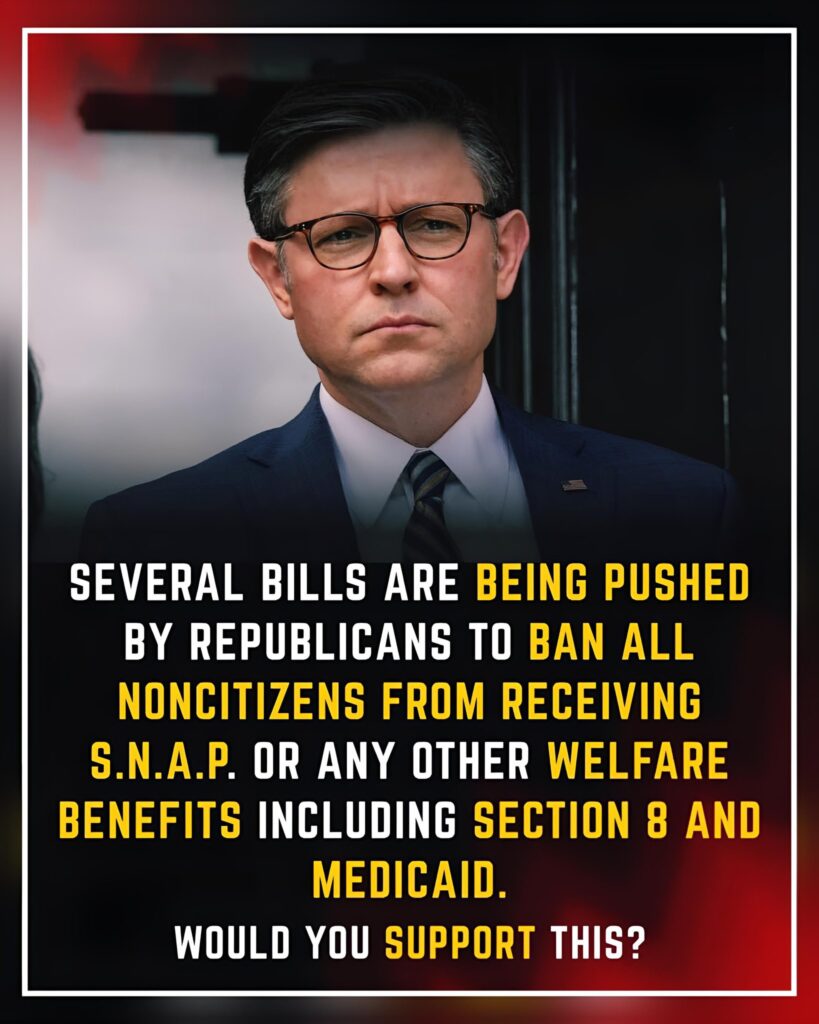
At the center of the debate were bills like H.R. 6854, known as the “No Welfare for Non-Citizens Act,” and H.R. 7213—both aiming to restrict federal benefits strictly to verified U.S. citizens.
On paper, the idea was simple:
Limit programs like SNAP, Medicaid, and Section 8 housing to citizens only.
Supporters argued it was about fairness.
“Taxpayer-funded benefits should go to American citizens first.”
A statement repeated in interviews, speeches, and headlines.
Clear. Direct. Hard to argue against—at least on the surface.
But policies don’t exist in a vacuum.
They ripple.
Across the country, millions rely—fully or partially—on federal assistance programs.
Supplemental Nutrition Assistance Program helps families afford groceries.
Medicaid provides healthcare for those who can’t otherwise pay for it.
And housing assistance offers stability in an economy where rent continues to rise.
For many, these aren’t luxuries.
They are lifelines.
According to estimates from the Congressional Budget Office, tens of thousands of people could lose access to programs like SNAP if the proposals become law.
Tens of thousands.
Not numbers on a spreadsheet.
People.
In a small apartment complex on the edge of a Midwestern city, the news spread slowly.
A notification here.
A social media post there.
Then conversations.
Real ones.
“Does this mean we lose everything?”
“Are we still eligible?”
“What happens next?”
No one had clear answers.
Only uncertainty.
Meanwhile, beyond Washington, the movement wasn’t standing still.
States like Iowa and Tennessee began pursuing similar policies at the local level, echoing the same principle:
Benefits should be reserved for citizens.
The message was gaining momentum.
And with it… consequences.
Supporters stood firm.
They argued the system had limits.
That resources were finite.
That prioritizing citizens wasn’t exclusion—it was responsibility.
They pointed to rising costs, strained programs, and the need for accountability.
To them, this wasn’t harsh.
It was necessary.
But critics warned of something deeper.
They argued that many non-citizens contribute to the very system now being restricted.
They work.
They pay taxes.
They fill essential roles in industries that depend on them.
Removing access to benefits, they said, wouldn’t just impact individuals—
It could destabilize entire communities.
Hospitals could see more uninsured patients.
Schools could face families under greater stress.
Local economies could feel the pressure as spending drops.
Because when one part of a system shifts—
Everything connected to it moves too.
Back in that apartment complex, life didn’t pause for policy debates.
Bills still needed to be paid.
Children still needed to be fed.
Work shifts still started early in the morning.
But something had changed.
A quiet tension now lived in everyday routines.
Checking the mailbox felt different.
Logging into benefit accounts felt heavier.
Even grocery shopping carried a new kind of anxiety.
Not about what to buy—
But whether help would still be there next month.
Weeks turned into months.
Debates intensified.
Headlines grew louder.
And the divide became clearer.
On one side:
A call for prioritization.
A push for reform.
A belief in protecting taxpayer resources.
On the other:
Warnings of humanitarian impact.
Concerns about fairness beyond citizenship status.
Questions about who truly gets left behind.
And in the middle?
Millions of people waiting.
Watching.
Hoping.
Because for them, this wasn’t about politics.
It wasn’t about ideology.
It wasn’t even about policy language.
It was about something much simpler.
And much more urgent.
Food on the table.
A doctor when they’re sick.
A roof over their heads.
And as decisions continue to move forward in Washington and beyond, one question refuses to fade:
When policies change… who carries the weight of those changes the most?
Because in the end—
Behind every bill, every vote, every statistic—
There are lives being rewritten in real time.