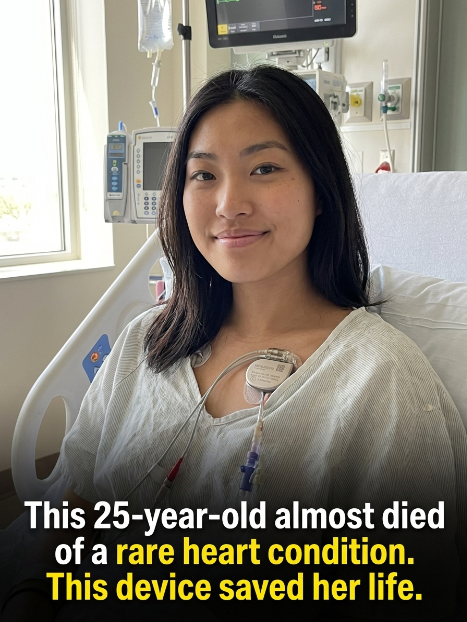
Emma Collins had always been strong.
At 24 years old, the Louisville, Kentucky native lived an active, disciplined life. A former Division I basketball player, she spent years pushing her body to its limits—running drills, lifting weights, and competing at a level most people could never imagine. Even after leaving competitive sports, Emma kept that same routine. The gym was her second home.
So when something felt off one morning in November, she noticed immediately.
It started small.
A strange tightness in her chest. A shallow breath that didn’t feel quite right.
At first, she brushed it off.
But within hours, it became harder to ignore. Every deep breath felt uncomfortable, like something inside her chest was resisting. Concerned, she went to the emergency room.
Doctors diagnosed her with pleurisy—inflammation of the lining around the lungs. It sounded manageable. She was sent home with anti-inflammatory medication and reassurance that she would recover quickly.
For a moment, it seemed like they were right.
Emma started to feel slightly better.
But just days later, everything changed.
Her symptoms came back—stronger, stranger, and far more alarming.
She began waking up in the middle of the night drenched in sweat. Not just light perspiration—her sheets were completely soaked. At the same time, she felt freezing cold.
“I had to sit in a hot bath every morning just to feel normal again,” she later said. “I couldn’t get warm.”
Breathing became a constant struggle.
Lying flat was impossible. Every time she tried, it felt like her chest was being compressed. She had to prop herself up with pillows just to sleep.
Even more concerning—her heart rate was out of control.
While sitting still, doing absolutely nothing, her pulse would jump into the 130s… sometimes even the 140s.
That’s when her wearable device started warning her.
Emma wore a WHOOP fitness bracelet every day—a device designed to track recovery, heart rate, and strain. Normally, it helped her optimize workouts.
But now, it was telling a different story.
Without exercising at all, her body was showing extreme strain. Her recovery scores dropped. Her resting heart rate climbed higher than she had ever seen.
Something was seriously wrong.
Still, answers didn’t come easily.
Over multiple visits, doctors ran test after test—bloodwork, scans, imaging—but nothing immediately explained the severity of her symptoms.
Meanwhile, Emma’s condition continued to deteriorate.
Simple movements left her exhausted. Her breathing worsened. Her body felt like it was shutting down slowly, piece by piece.
Finally, after further testing—including a CT scan and an echocardiogram—doctors discovered the truth.
Emma wasn’t just dealing with inflammation.
She had developed pericarditis—swelling around the heart.
But it had progressed into something far more dangerous.
Cardiac tamponade.
A rare and life-threatening condition where fluid builds up around the heart, putting pressure on it and preventing it from pumping properly.
Time was running out.
By the time doctors fully understood what was happening, Emma’s condition had become critical.
During emergency surgery, doctors drained 871 milliliters of fluid from around her heart.
Nearly a full liter.
The pressure had already caused severe damage.
Her left lung had collapsed.
Her left ventricle—the heart’s main pumping chamber—was compressed.
Fluid had begun affecting the right side of her heart.
“She was hours away,” her mother later said. “If we had waited any longer… she wouldn’t be here.”
Doctors told the family the truth:
Emma likely had 24 to 48 hours left to live.
Looking back, Emma believes something made the difference.
Not just luck.
Not just timing.
But the constant warnings she couldn’t ignore.
Her WHOOP bracelet.
The same device she once used to track workouts had been silently alerting her that her body was under extreme stress—even when she wasn’t exercising.
It pushed her to keep seeking answers… even when the first diagnosis didn’t fully explain what she was feeling.
Today, Emma is recovering.
Stronger. More aware. And deeply grateful.
Her story is now spreading online—not just because it’s shocking, but because it’s a reminder.
Sometimes, the body whispers before it screams.
And sometimes, the smallest signals… can save your life