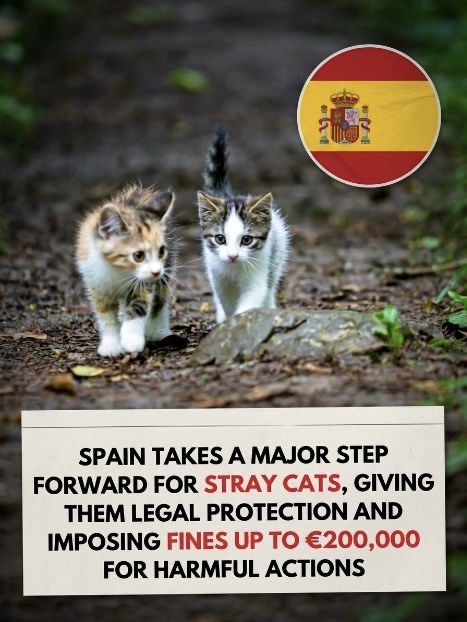
In a landmark decision that could reshape the way the world treats stray animals, Spain has officially recognized and protected stray cat colonies, giving them legal status and establishing a framework for their humane management. This groundbreaking move is being hailed by animal welfare advocates as a major step forward in the fight for compassionate coexistence between humans and animals.
Under the new law, municipalities across the country are now responsible for the care and management of stray cat colonies, using scientifically backed and humane methods. These include feeding programs, regular health monitoring, and sterilization initiatives designed to responsibly control cat populations over time. The legislation ensures that these animals are not simply seen as pests to be removed or eliminated, but as living beings deserving of protection, respect, and care.
Violations of the law carry significant consequences. Harming, removing, or attempting to eliminate stray cats is now considered a serious offense, with fines that can reach up to €200,000. This stringent measure reflects the seriousness with which Spain is approaching the welfare of vulnerable animals, signaling that cruelty toward them will no longer be tolerated.
But the law represents far more than just regulation. Experts describe it as a cultural and societal shift—a reimagining of humanity’s relationship with animals. By giving stray cat colonies official status and emphasizing humane care, Spain is recognizing that these animals are part of the urban ecosystem, deserving coexistence rather than fear, hostility, or eradication.
Animal welfare organizations have praised the law as a milestone in the global movement toward compassionate animal management. The legislation not only benefits the cats themselves but also strengthens communities by promoting responsible, long-term solutions to issues like overpopulation and public health. By ensuring that cats are monitored, fed, and sterilized, cities can prevent future conflicts and maintain harmony between humans and animals.
Spain’s approach also serves as a model for other countries seeking humane solutions for stray animal populations. Rather than resorting to culling or displacement, this law demonstrates that society can address challenges ethically, scientifically, and sustainably. It shows that coexistence is not only possible—it is essential for building a kinder, more compassionate society.
For the residents of Spain, this law is already changing perceptions. People who may have once considered stray cats a nuisance are now encouraged to participate in their care. Volunteers, local authorities, and animal lovers alike are working together to create safe environments for these cats, transforming once-neglected colonies into thriving, well-managed communities.
As the world watches, Spain’s commitment to animal welfare stands as a powerful reminder: progress happens when humanity chooses compassion over cruelty. This historic legislation doesn’t just protect stray cats—it redefines how societies can live in harmony with the animals around them, setting a precedent for ethical urban coexistence that other nations may soon follow.
Imagine a world where stray cats are protected, cared for, and respected.
In Spain, that world just became a reality:
- Municipalities manage colonies with feeding, health checks, and sterilization programs.
- Harming or removing cats can cost up to €200,000.
- Communities are learning to coexist peacefully with animals instead of fearing or removing them.
Animal lovers everywhere are calling it a global example of compassion in action.