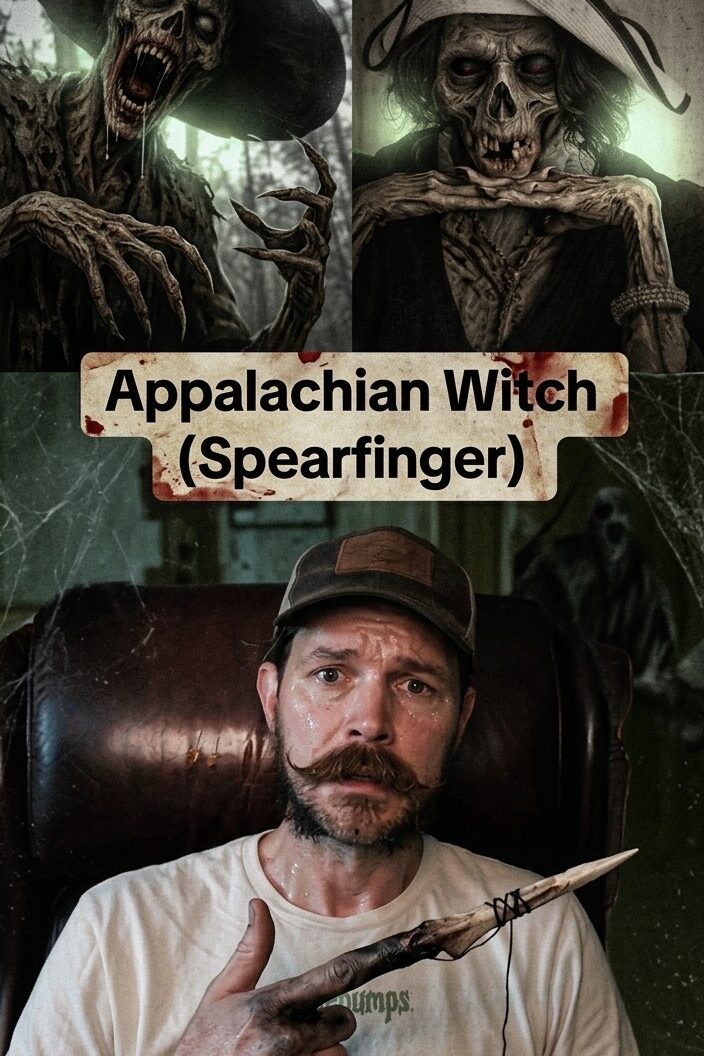
THE APPALACHIAN WITCH — THE NIGHT SPEARFINGER WALKED THE RIDGE
THE APPALACHIAN WITCH — THE NIGHT SPEARFINGER WALKED THE RIDGE
Ask anyone who grew up in the Appalachian Mountains and they’ll tell you the same thing:
There are stories you hear for fun, and there are stories you hear so you know what not to do in those woods after dark.
And Spearfinger?
She belongs to the second category.
Up in the Smoky Mountains, where the fog settles thick enough to swallow an entire cabin, her legend has been whispered for generations by Cherokee elders. They say she’s older than the trees. Older than the ridgelines. Older than anything human eyes have ever seen.
But the way most people know her is simple:
The Witch With the Stone Hand.
They say she doesn’t walk.
She glides, quiet as a shadow.
And you never hear her coming—only the forest going unnaturally still.
The night my grandfather swore he saw her, the world around him felt wrong long before he understood why.
⸻
THE SETTING — A MOUNTAIN THAT HID ITS BREATH
It was late October, one of those cold mountain nights where the air feels sharp against your skin. My grandfather, a man who had spent his entire life in those woods, was hiking home after checking on his traps near the Tennessee border.
The trail was familiar.
The trees were familiar.
Even the wind was familiar.
But the silence wasn’t.
Mountains aren’t quiet. They crack, groan, whisper, and breathe. But that night, everything went still. No crickets. No owls. No wind sliding through the branches.
Just a heavy quiet that made the hair on the back of his neck stand up.
He tightened the strap of his lantern and kept walking, pretending he didn’t notice the shift. Old mountain men always pretend they’re not scared, even when fear is sitting right behind their ribs.
About ten minutes later, he saw something strange up the ridge:
A shape.
Still.
Tall.
Wrong.
It looked like someone standing perfectly still between the trees.
He squinted. The lantern flickered. That’s when he noticed something even worse.
The birds that were supposed to be sleeping suddenly took off all at once—launching from branches higher up the ridge, fleeing deeper into the forest as if they’d been spooked by something he couldn’t see.
He’d lived long enough to know one thing:
Animals always know first.
⸻
THE LEGEND — HOW THE CHEROKEE WARNED THEIR CHILDREN
The Cherokee called her U’tlun’ta.
Spearfinger.
A witch with a hand made of stone.
Sharp as flint.
Cold as the mountain rock.
She could mimic voices.
She could copy anyone she wanted.
She could call your name exactly the way your mother did, even if she’d been gone for years.
And the worst part?
She preferred to hunt in autumn.
When the fog thickened.
When the leaves fell silent.
When the mountains swallowed sound.
It was the perfect season.
⸻
THE MOMENT MY GRANDFATHER KNEW HE WASN’T ALONE
When he finally reached the old bridge crossing Mill Creek, he noticed footprints in the dirt. Large ones. Deep ones. Too deep for an ordinary person.
And they weren’t leading away.
They were leading toward him.
He tried to convince himself it was a hunter, maybe someone wearing heavy boots. But he kept walking, eyes lowered, pretending he didn’t feel the presence behind him.
But the air shifted.
The fog thickened unnaturally fast.
His lantern flickered again—once, twice—then glowed dimmer.
That’s when he heard it.
Not footsteps.
Not breathing.
Not movement.
A voice.
Soft.
Sweet.
Familiar.
Calling his name exactly the way his grandmother used to—before she passed.
He froze. Every muscle in his body locked. His breath hitched as the voice drifted again, closer this time, curling through the trees like mist:
“Come here…”
His grandmother.
Impossible.
Yet the voice was perfect. Every tone. Every little crack in her mountain accent.
He didn’t turn around.
He didn’t answer.
He didn’t move.
Old Cherokee stories teach one thing:
The moment you answer Spearfinger, she knows exactly where you are.
⸻
THE TURNING POINT — WHEN THE FOREST TOLD HIM WHAT TO DO
For a long moment, he stayed perfectly still. Then—quietly, slowly—he crouched down and set the lantern on the ground. The flame glowed weakly, but it was enough.
He noticed something in the trees behind him.
A silhouette.
Tall.
Thin.
Leaning slightly.
Not breathing.
And there, where a hand should’ve been, was something that reflected the light like polished stone.
The stories were true.
He didn’t run. Running in those mountains after dark gets you killed faster than anything else alive or dead.
Instead, he stepped off the trail the way hunters do—sideways, slow, blending into the trees like another trunk in the dark.
Spearfinger’s voice floated again.
This time closer.
Curious.
Listening.
He held his breath until his chest burned.
Minutes passed.
Then more minutes.
The shape near the lantern didn’t move. It simply tilted its head, as if listening for the faintest sound.
Then—suddenly—the lantern went out.
Darkness swallowed everything.
And something heavy slid across the leaves.
Not footsteps.
Not running.
Just… movement.
Slow.
Searching.
My grandfather stayed pressed against a tree until the sky began to lighten. Only when he heard morning birds chirping did he finally dare move.
And when he returned for the lantern later that week, he found it crushed flat—like something had stepped on it with unbelievable force.
⸻
THE AFTERMATH — A WARNING PASSED DOWN FOR GENERATIONS
My grandfather never went near that ridge again.
He never hiked alone at night again.
And he told every one of his children and grandchildren:
“Don’t answer voices in the mountains.
Don’t follow the fog.
And if the woods ever go silent—
Go home.”
People might call it superstition.
An old mountain tale.
A Cherokee myth carried into modern times.
But in Appalachia, folks don’t tell Spearfinger’s story for fun.
They tell it so you know what to fear when the forest suddenly stops breathing.