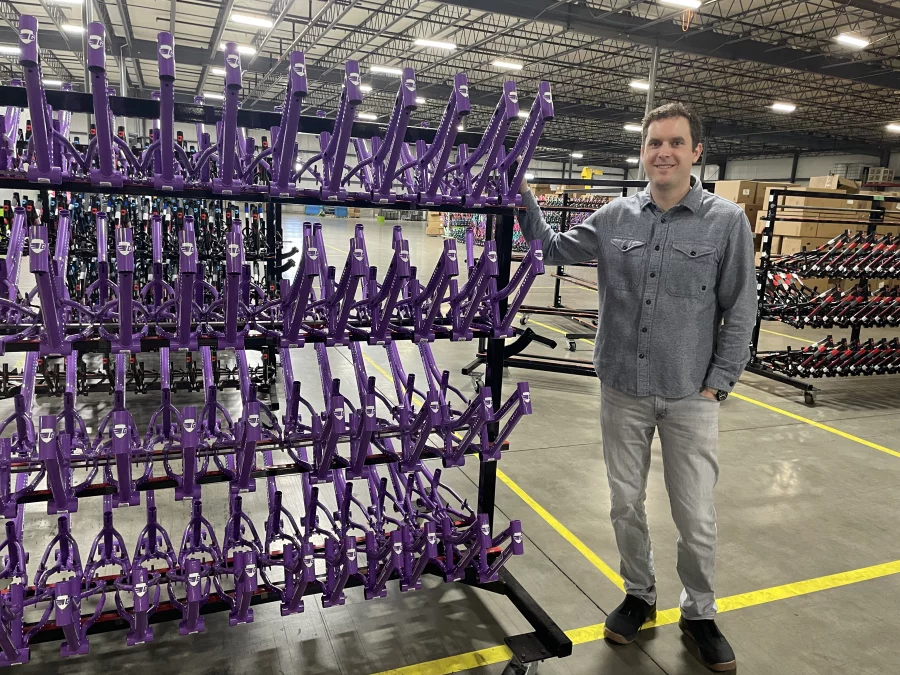
Brian Riley got into the bike business by accident. Two decades ago, his grandfather was riding his bicycle when he got cut off by a car, and squeezed his brakes in a panic.
“He over-applied his front brake and went flipping over the front of his handlebars,” Riley recalls. “He survived that accident but it was a really serious, traumatic experience that my whole family went through.”
So a few years later in college, Riley teamed up with some classmates and developed a new kind of bicycle brake they called the SureStop. It’s designed to slow front and back tires together, with a squeeze of a single lever.
“When you drive a car, you step on one pedal and your brakes just work,” Riley says. “That’s SureStop for a bike.”
When Riley began peddling this new brake to bike manufacturers, he quickly discovered they’re all based overseas. For decades, nearly all the bicycles sold in America have been imported. Even classic American brands like Huffy and Schwinn are primarily manufactured in China.
Riley wanted to put the brakes on that trend by opening his own factory in the United States. Now, he’s asking the Trump administration to give his bikes a push, by imposing higher tariffs on foreign competitors. It could become a test case of the administration’s strategy of using import taxes to promote domestic manufacturing. But it’s already drawing stiff opposition from bicycle retailers and importers.
Location, Location, Location
After years of studying Chinese bicycle factories, Riley began scouting locations to build his Guardian Bike Company in the U.S. He eventually settled on Seymour, Ind., a town of 22,000 halfway between Indianapolis and Louisville, Ky.
“Just being in a small town like this makes a huge difference on the community,” Riley says. “That was something we wanted as well.”
Seymour happens to be the birthplace of John Mellencamp, whose giant portrait fills the brick wall outside a downtown music store. The town is also a logistics hub, with good freeway and railroad access, and nearby mills that could supply Guardian with steel, a key ingredient for building bike frames.
“At the end of the day, it checked all the boxes that we wanted,” Riley says.
Most importantly, Seymour has a workforce that knows how to build things. Factories account for about 30% of the jobs in town — nearly four times the national average.
“This is an area that knows manufacturing,” says Jim Plump, executive director of the Jackson County Industrial Development Corporation.
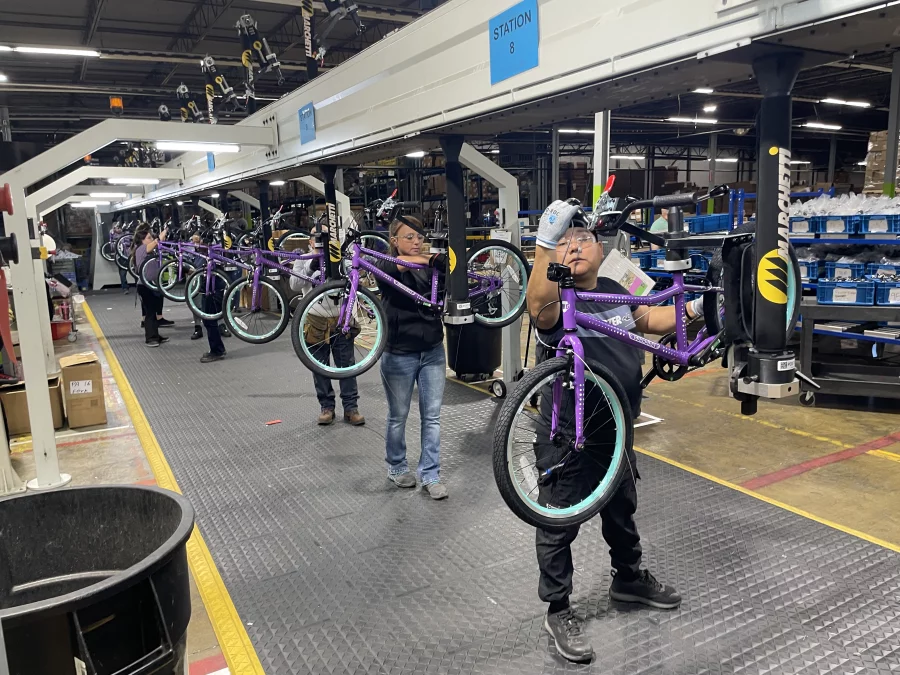
Robots and lasers help keep costs in check
Riley’s company started slowly at first, assembling bikes in Indiana from imported components. But last year, Guardian went all in, and began building “Made in the USA” bikes from the ground up.
The operation now fills several buildings in a Seymour industrial park. It’s just the kind of home-grown enterprise President Trump’s tariffs are supposed to encourage.
But Riley knew that to compete with low-cost Chinese bike-makers, he would have to be super-efficient. Where a Chinese factory might employ a small army of workers to cut and bend steel into the pieces for bicycle frames, that work is largely automated at Guardian, relying on robots and high-powered lasers.
“That fiber laser can just cut through steel like butter,” Riley says, pointing to a $1.2 million machine.
Wages at Guardian start around $22 an hour, plus benefits. But it takes only a handful of people to assemble the bike frames.
“The hard, complicated work of welding is being done by robots and the humans are just working with the robots,” Riley says. “These four guys are ridiculously productive because they’re getting four- or 500 frames a day with four people.”
The steel for those frames comes from a tube mill in Columbus, Indiana, just 20 miles up the road. By keeping its supply chain short, and building and painting bikes in-house, rather than an ocean away, Guardian can adjust quickly to any sudden change in demand.