It started on a rainy November night in Ridgefield, Washington. Mara Lewis, a young writer with a sharp curiosity, had just moved into an old Victorian house she’d inherited from her grandmother. The house was beautiful, with its tall windows, intricate woodwork, and creaking stairs—but there was a heaviness about it, a subtle tension that made her skin prickle. Her grandmother had often warned her that the house had “a soul,” but Mara, ever rational, had laughed it off as old superstition.
The first few days passed quietly. Mara unpacked boxes, arranged her furniture, and explored every corner. The house was dusty and dimly lit, but nothing felt threatening—until she started hearing it.
It began with whispers. Soft, unintelligible murmurs at first, seeming to drift from the walls themselves. Mara told herself it was the wind through the broken shutters, the old plumbing, or the stress of moving. But the whispers didn’t stop. They grew louder at night, more insistent, sometimes forming words she could almost understand.
Then came the cold. She would sit reading, and suddenly her body shivered, despite the heater running full blast. Her breath fogged in the air, and the shadows in the corners of the room seemed to thicken, creeping closer with each passing night.
One evening, while exploring the attic, Mara found a small, intricately carved box sitting on a shelf she had never noticed before. It was dark wood, worn with age, and etched with symbols she couldn’t recognize. A strange compulsion took hold of her: the whispers urged her to pick it up, to open it, to “see.”
Mara hesitated. Her instincts screamed to leave it alone, but the voice of curiosity was louder. Slowly, she lifted the lid.
Inside was a small figurine, humanoid in shape, with eyes so dark they seemed like tiny voids. The moment she touched it, the room plunged into an unnatural cold. The lights flickered. Shadows stretched unnaturally across the walls. And then she heard it: a deep, guttural voice that was not human, whispering her name.
“Thank you for letting me in.”
Mara stumbled back, dropping the figurine, but when she looked, it hadn’t moved. Yet the air was charged with an oppressive energy. The whispers now weren’t just in the corners—they seemed to come from inside her own head, urging her, mocking her, laughing at her fear.
Days passed, and nothing in her life was normal. Objects shifted when she wasn’t looking, doors opened and slammed, the shadows moved independently of the light. At night, she would wake to the sensation of being watched—sometimes feeling breath on her neck, sometimes seeing her reflection in the mirror grin back at her when she was dead serious.
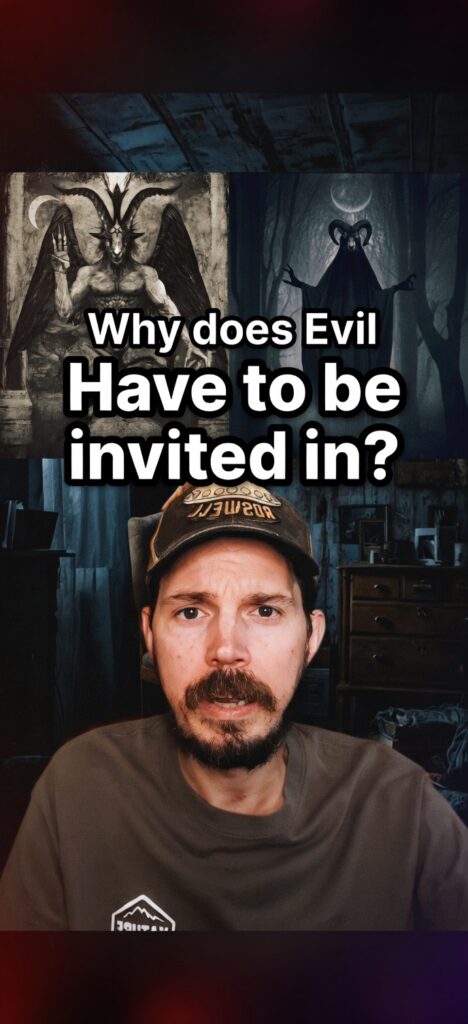
Mara’s friends noticed her change. She became withdrawn, jumpy, and paranoid. But when she tried to explain, the words sounded absurd even to her own ears. She searched online, seeking logical explanations, but what she found was chilling: legends of the Navajo Skinwalker, demonic entities, spirits that cannot enter on their own—they require an invitation.
Her grandmother’s old diary, tucked away in a drawer, confirmed it. Pages yellowed and brittle warned:
“Never answer the call of curiosity. Never let it cross the threshold. Evil waits for the invitation. Once given, it never leaves. And it is patient… unimaginably patient.”
Mara realized in horror: by opening that box, she had invited it in. The entity didn’t need to attack; it only needed a doorway—and she had handed it over willingly, without knowing.
The nights grew worse. The air in the house grew thick, oppressive, almost suffocating. The whispers became voices, sometimes shouting in tongues she didn’t know, sometimes mocking her in her own voice. She started seeing things in broad daylight—shadows stretching from nowhere, movements in the corners of her eyes, reflections of people who weren’t there.
She tried to burn the figurine. The fire died instantly. The smoke didn’t rise. It was as if the house itself rejected the attempt. Mara began leaving sage and salt around the rooms, trying rituals she barely understood. Sometimes it worked—temporarily—but the entity always returned. Stronger, smarter, hungrier.
On the seventh night after discovering the box, Mara awoke to find herself unable to move. The darkness had coalesced into a shape at the foot of her bed: a figure, faceless, limbs too long, eyes black as the void, and a grin wider than humanly possible. It leaned close, whispering, “You invited me. You cannot send me away.”
The next morning, Mara was gone. The neighbors found the house locked, the lights off, not a sound inside—except for a soft whispering, barely audible, as if carried on the wind:
“Who will invite me in next?”
The house still stands. The box remains on the attic shelf, untouched. And every so often, late at night, passersby swear they hear whispers carried on the wind. Curiosity is a door, they say. And evil is always waiting on the other side.
Because the truth is terrifyingly simple: evil cannot enter without an invitation—but it doesn’t need much. A glance, a touch, a question—sometimes that’s all it takes.