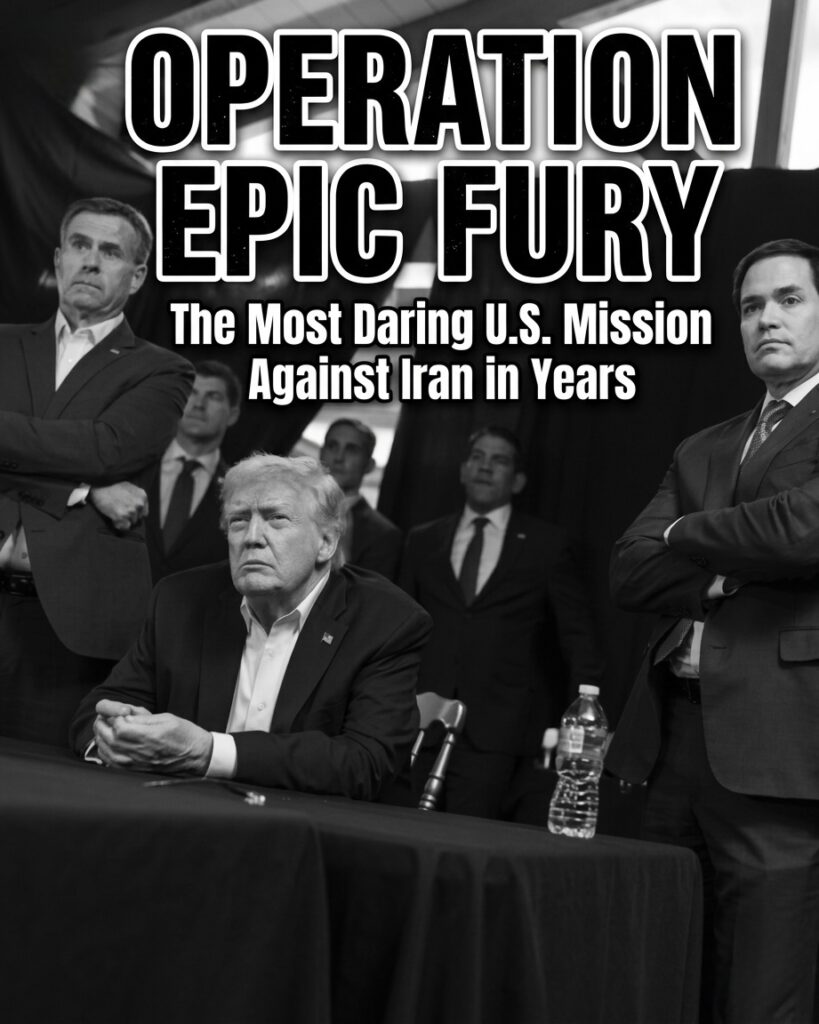
The United States launched one of its largest and most dangerous missions in recent history after an American F-15E Strike Eagle went down inside Iranian territory. President Donald Trump immediately labeled the mission Operation Epic Fury, signaling that the U.S. had no intention of backing down.
How it all started
Two American pilots were forced to make an emergency landing deep inside Iran, in an area heavily controlled by the Iranian Revolutionary Guard. Within minutes, the Pentagon kicked off a massive search-and-rescue mission described by officials as “like trying to find a grain of sand in the desert.”
The U.S. deployed an enormous amount of military power:
• fighter jets
• special-operations helicopters
• surveillance drones
• intelligence units
• elite commando teams
A full operational ring was set up around the region, covering large portions of the airspace near Iran’s border.
The rescue
After hours of searching under extreme pressure, American forces located one of the pilots. He was extracted from hostile territory in a high-risk operation while Iranian units were closing in.
Medical teams treated him immediately, and he was flown to a U.S. base in the region. Officials called it one of the toughest rescues in years.
The second phase: U.S. airstrikes on key Iranian targets
While the rescue was underway, U.S. forces also launched a series of precision strikes on major Iranian assets:
• strategic storage sites
• energy and oil infrastructure
• military positions on Kharg Island, one of Iran’s main oil hubs
• radar and air-defense locations
These strikes came after Trump warned Tehran that if it continued restricting traffic through the Strait of Hormuz, the U.S. would hit even harder.
How many forces were involved?
Based on global reports:
• hundreds of aircraft were activated
• dozens of special-operations teams were involved
• multiple U.S. intelligence agencies worked around the clock
• CENTCOM coordinated the entire operation
Foreign outlets say this may be one of the largest search-and-rescue mobilizations ever carried out in modern U.S. military history.
Iran’s response
Iran said its “patience is over” after the strikes on its infrastructure. Iranian officials promised a response but didn’t say how or when.
The Strait of Hormuz remains the most dangerous choke point right now. A shutdown there would impact more than 20 percent of global oil shipments.
What comes next
U.S. forces remain on high alert. Washington has increased:
• air patrols
• naval presence
• satellite and drone surveillance
Trump has made it clear that if Iran escalates, Operation Epic Fury will not be the last strike.