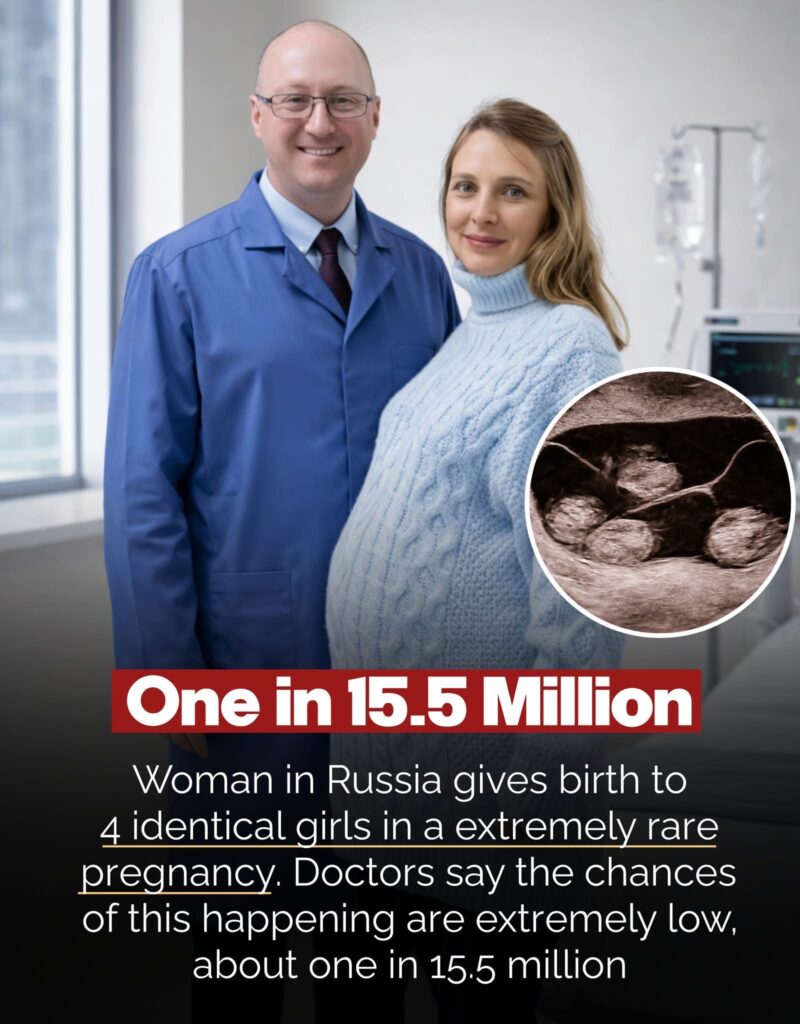
Most days in the maternity ward of St. Petersburg pass with the familiar rhythm of new life arriving into the world. Crying newborns. Exhausted mothers. Proud fathers. Doctors moving with calm precision. But on this particular morning, the staff witnessed something so rare that it left even the most experienced specialists speechless.
A young woman came in for what was expected to be a risky, closely monitored delivery. Everyone in the room knew the pregnancy was complicated. What they didn’t fully grasp was just how historic it would become.
When the first baby girl arrived, the room filled with the usual excitement. But then came another… and another… and another. Four baby girls. All identical. All from one single fertilized egg that had split again and again — a biological event almost no one ever sees in their lifetime.
Monochorionic quadruplets.
A phrase most people will never hear, let alone witness in person.
Statistically, this kind of birth sits somewhere around 1 in 15.5 million. To put it in perspective: there are fewer documented cases of identical quadruplets in the world than there are people who’ve climbed Mount Everest blindfolded. Doctors in Russia believe this may be the first recorded case of its kind in the entire country.
The delivery team worked carefully and quickly. The pregnancy had been extremely high-risk since all four babies shared the same placenta. Any complication affecting one could affect them all. But nature — against every odd — decided to play in their favor.
One by one, the newborn girls were gently placed under warm lights. Their first numbers were tiny but hopeful:
• Between 1,140 g and 1,400 g
• Measuring 37 to 41 centimeters
Small, delicate and impossibly alike — four tiny sisters who already shared more than most siblings ever will.
The doctors checked them again and again. Stable. Breathing. Stronger than anyone expected for such a rare case. Their mother, overwhelmed and tearful, held out her hand toward them, knowing she had just become part of medical history.
Globally, only around 15 similar cases have ever been recorded. Most of them involved girls, but the reason behind this strange phenomenon remains a mystery. No known genetic pattern. No clear explanation. Just pure chance mixed with the quiet magic of biology.
A single beginning. Four lives.
In a world full of chaos, noise and uncertainty, moments like this remind us how extraordinary life can be when science, luck and nature collide.
And somewhere in St. Petersburg, four little miracles are sleeping side by side — identical in every way, yet destined to grow into four completely different stories.