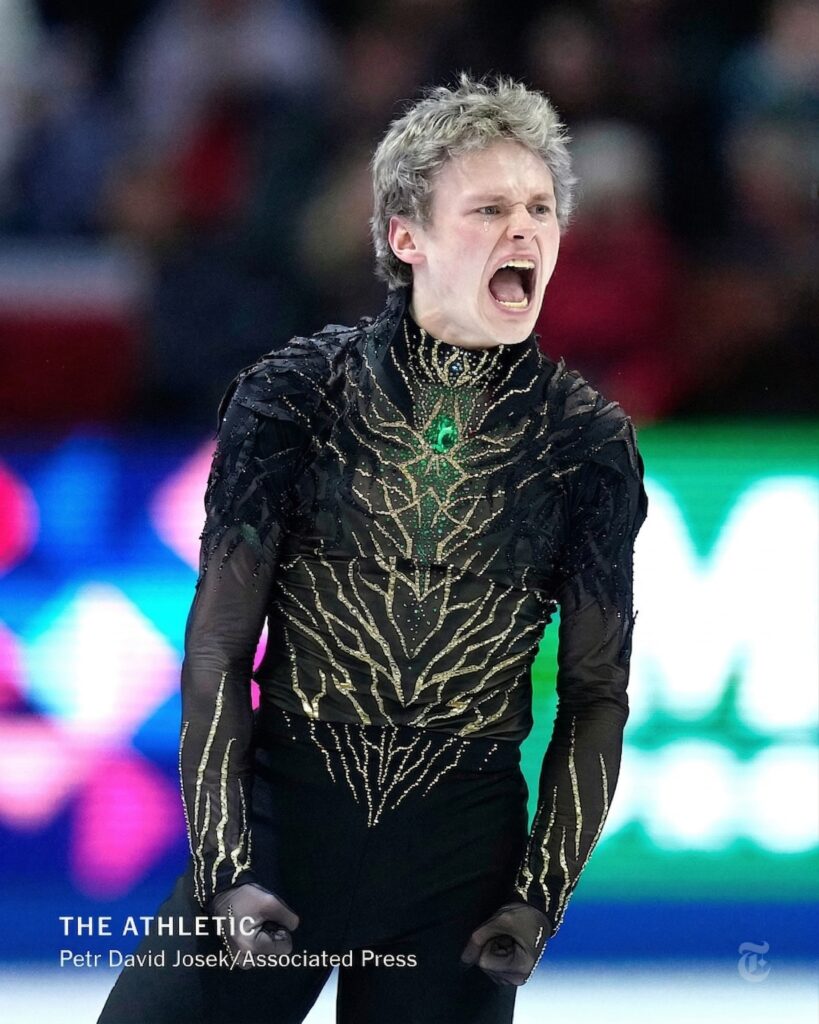
Six weeks can feel like a lifetime in the world of elite sports. For Ilia Malinin, it was the exact amount of time needed to travel from the darkest depths of his career back to the absolute summit.
When the 21-year-old American phenomenon took the ice at the 2026 ISU World Figure Skating Championships in Prague, the ghost of the Milano Cortina Winter Olympics still lingered. Just a month and a half prior, the man affectionately known to millions as the “Quad God” had stepped onto the Olympic ice as the overwhelming, undisputed favorite for gold. But under the crushing, suffocating weight of global expectations, he crumbled. In a stunning turn of events that left fans in shock, Malinin fell twice in his free skate, singled a planned quad axel, and tumbled to a heartbreaking eighth-place finish. Critics whispered about the pressure, and the heavy burden of being a once-in-a-generation talent seemed to have temporarily broken him.
But the true measure of a champion isn’t how they handle the pedestal—it’s how they climb out of the abyss.
In Prague, Malinin didn’t just win his third consecutive World title; he delivered a masterclass in mental fortitude. The significance of his bounceback was crystal clear to everyone watching, as perfectly summarized by The Athletic: The sport of figure skating desperately needs the Quad God on his game.
This time, the strategy was entirely different. Malinin stripped away the impossible expectations and the deafening noise of the outside world. He openly admitted that the Olympic pressure had paralyzed him, so he arrived in the Czech Republic with a singular, refreshing goal: to skate for himself and actually enjoy the moment.
Opting for a slightly more conservative—yet still mind-bogglingly difficult—five-quad free skate, Malinin performed with a renewed sense of freedom and fierce intensity. He didn’t even need his pioneering quad axel. Instead, he piled up massive points with soaring combinations, including a spectacular quad toe loop-triple toe loop that earned the highest score of the entire event. To cap it all off and prove his joy was back, he threw in a crowd-igniting backflip for good measure.
When the music stopped, the sheer relief washed over him. He shouted, punched the air, and let the heavy burden of the past six weeks melt into the ice. Earning a massive overall score of 329.40, he completely obliterated the field, outpacing the silver medalist, Japan’s Yuma Kagiyama, by nearly 23 points.
Figure skating needs Ilia Malinin at his best because he represents the exhilarating edge of what is humanly possible. He is the sport’s greatest showman and its most daring pioneer, bringing a viral, electric energy to the ice that captures audiences well outside the traditional skating fandom. His Olympic performance proved he was beautifully human, but his triumphant redemption in Prague proved he is a resilient legend in the making.
He didn’t just win a gold medal; he won back his joy. And for the rest of the figure skating world, the Quad God has officially returned to his throne.